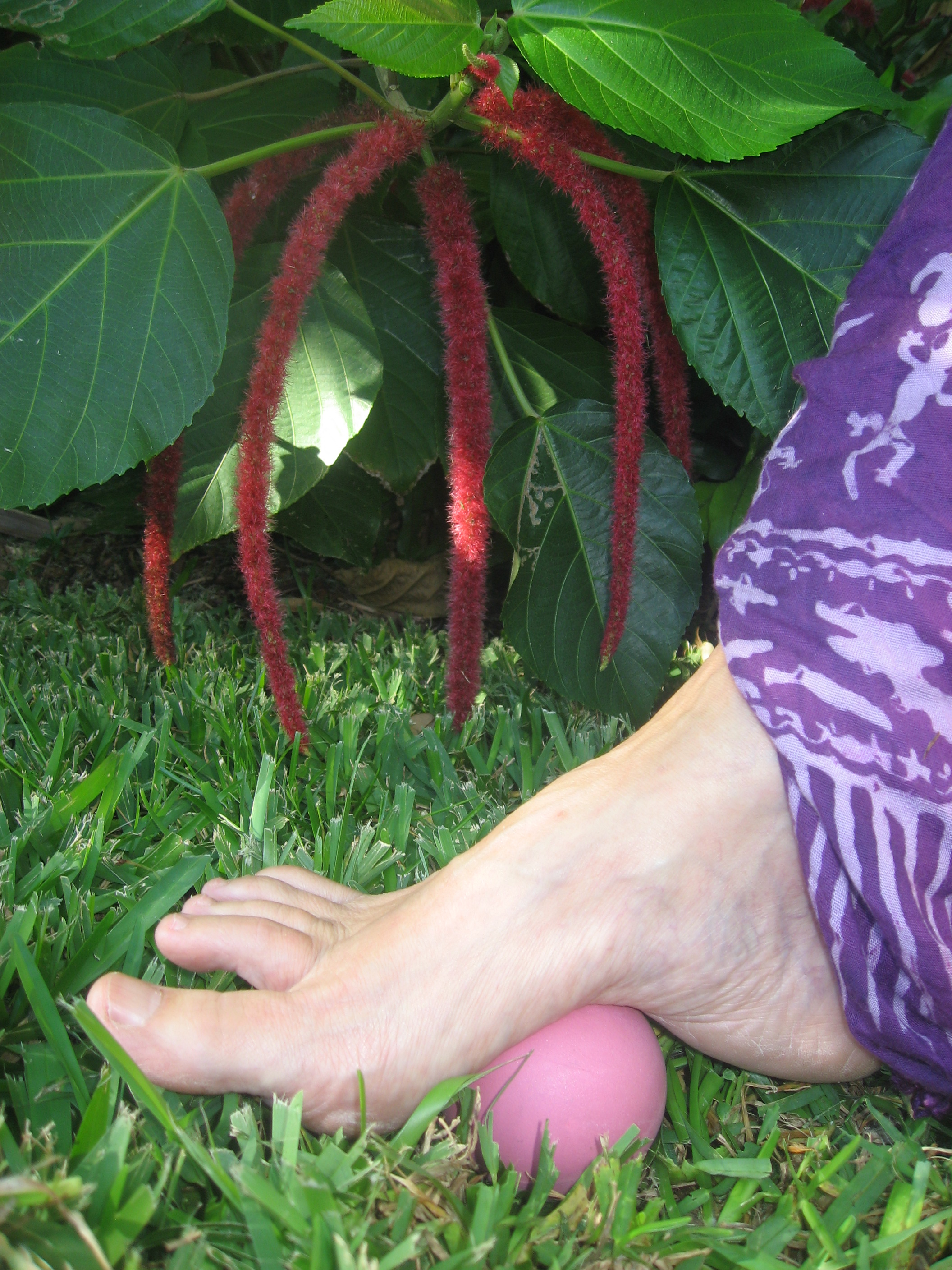
No, not that kind–tennis ball sized ones, hardish and bouncy, perfect for getting to those pressure points under your achy feet.
Roll the ball in little circles–under the arches, around the heels. Move it up and down, like a roller, under the balls of your feet. Push straight down to apply more pressure. Then pick it up and roll it with your hands over the base of your toes.
Essential Life Motto: If it feels good, do it. When it doesn’t, stop.
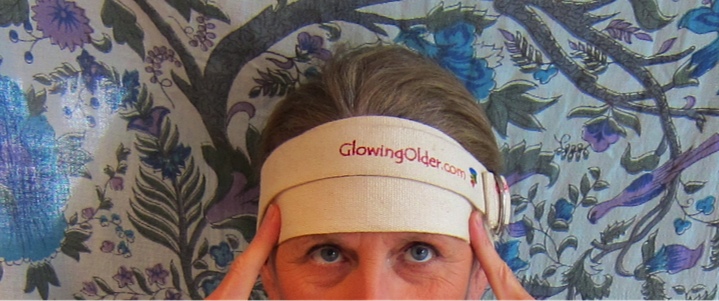
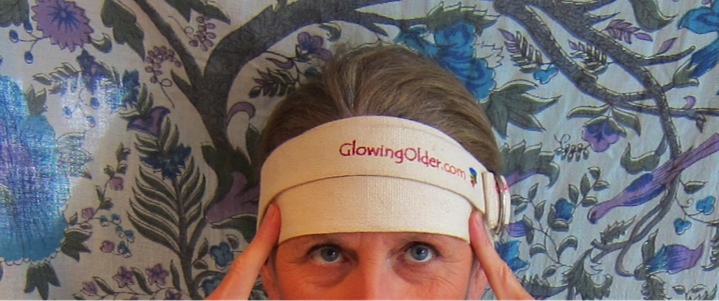
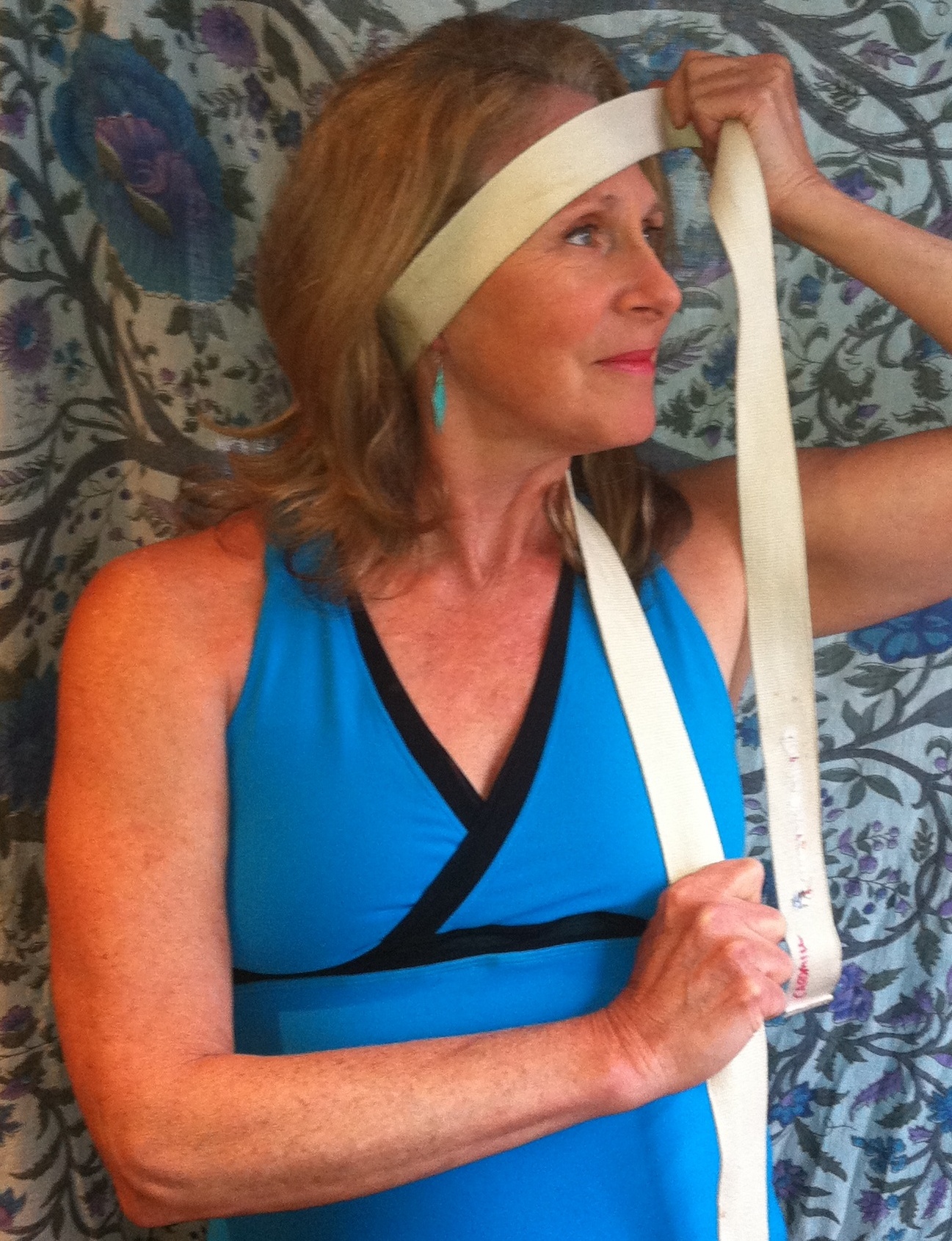
Thinking about getting creative with your strap? Here are some ideas for your upper body. HEAD Suffer from pounding headaches? While this is not what you’d call an evidence-based holistic health tip, it sure helps me: Tie a yoga strap around your head, putting light pressure (not too much, eh?) on your temples or eyes, whatever parts are pulsating. You may not like the way you look, but you’ll probably feel some relief. If the headache’s really bad, lie down and try to sleep it off, wearing your new head gear. (If your partner obliges, you can also try this.)
NECK Are you losing the ability to rotate your neck right and left, which can happen as you glow older? That movement is really important for driving, says physiotherapist Shelley Alper. If you sleep on your stomach with your neck turned to one side, you’re likely to get tight on the opposite one, she explains.
Here’s an exercise she can vouch for:
With the upper portion of the strap in your left hand, twist your head and neck to the left, pulling down on the strap in your right hand.
Repeat on the other side. If you feel pain or dizziness, stop immediately. (Shelley’s got more neck tips here.)
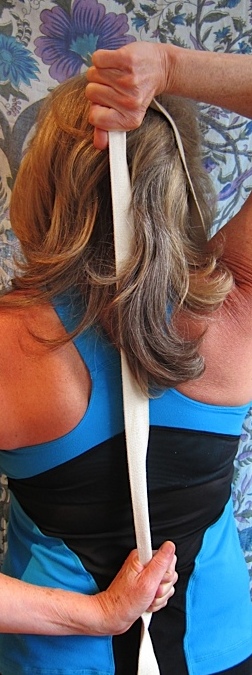
SHOULDERS Our shoulder joints also stiffen with age. Shelley suggests this strap trick for stretching the shoulders:
Exercise A: Hold the top of the strap with your right hand and the bottom of the strap with your left hand. (You’ll have to bend your elbows. ) Pull up with your top hand, letting the movement also pull your bottom hand up your back a bit. Then, pull down with your bottom hand, and let the movement pull your top hand down as well.
Exercise B: Repeat the above but switch hands, holding the top of the strap with the left hand and the bottom with the right.
I know they’re not what you’d call environmentally acceptable, but they’re so darn versatile—and cheap—that everybody should have two of them.
One you’ll use traditionally. Bend the long piece of foam into a semicircle, and hold it in front of you as you kick your legs in water. Keep it far enough away so that you engage your abs. Then lounge on the deck with it, supine, placing your noodle under your neck for support.
The second noodle you’ll carve with a bread knife into matching sets of foot-long (or so) baby noodles.
Place baby noodle here
Take two and go for a swim–one in each hand, doing breast stroke, working your way up to crawl.
Or lie down and place one under your head horizontally. Make sure you’ve placed it properly so that your chin drops down toward your chest..
“This is a great stretch for the soft tissues and muscles at the back of your neck,” says physiotherapist Shelley Alper. “Most of us sit all day at computers, with our chins jutting forward. The muscles and soft tissues around our necks get really tight,” she explains. Baby noodles are a yummy relief
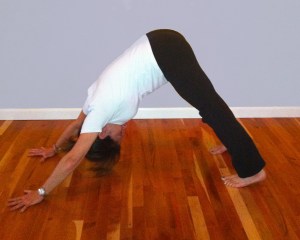
What’s so good about downward dog? Here’s physical therapist Shelley Alper’s long list of how this yoga position helps. Next, you’ll want to find a yoga teacher who can make sure you’re positioning yourself correctly. Ask her to pull your hips back and stretch you out some more.
Believe me, I’m all in favor of a plant based diet, but all plants are not created equal.
One of the biggest problems is that in an attempt to satisfy our hunger, we go overboard on the carbs. Pasta, bread, potatoes and grains often pile up on our plates. And all of these carbs, even whole grains, will raise blood sugar, to varying degrees.
The standard macrobiotic diet recommends that half our consumption be of whole grains. That’s WAY too much.
Beans, nuts, seeds and grains and the oils made from them have yet another downside. Like animal foods, they all contain omega 6 fatty acids. (Notice I didn’t mention olive oil. It’s not a problem.) Omega 6s from animal foods get converted into inflammatory compounds in the body. In plant foods, the process could go either way—yielding either inflammatory or anti-inflammatory agents, depending on lots of other things going on in your body that you can’t necessarily control.
Raw food cookbooks have all sorts of scrumptious concoctions made largely from these ingredients— bean dips, crackers from seeds, fake cheeses and ice cream made from nuts. Yum. But watch your portions.
Fruits? Speaking of blood sugar, some are just entirely too sweet. Bananas, grapes, melons, for example. Dried fruits and juices. You can tell the bad guys with your taste buds. Go for apples, pears, berries instead. And grab some extra protein, fiber or fat to help keep your blood sugar more even.
What about the rest of the veggies? Even those are not all created equal. Again, sweet and/or starchy ones will raise blood sugar; again, combine with other foods and limit portions. Instead, load up on leafy greens, crucifers and alliums (the onion and garlic family, stinky but powerful.)
Is animal protein necessary? Under normal circumstances, probably not, other than the Vitamin B 12 issues, although I have to admit that when I do cheat, animal protein quells my insatiable desire to eat. There’s also something important in certain fish that our bodies can’t get efficiently from any other food source—long chain omega 3 fatty acids, which Dr. Andrew Weil can tell you all about. Of course, as my cousin- I’ve- never- met Dave Sugar might suggest, you could always take an algae supplement instead.
The race is on–the race to find the small molecules that might fight COVID-19. Canada’s Dr. Michel Chrétien, brother of a former Prime Minister, is hedging his bets on quercetin, small molecules abundant in plants. Should you, too, hedge your bets? Continue reading →
Life is all about managing risks to protect ourselves and our loved ones– likelihood of risks? gravity of risks? consequences of taking or not taking actions?
I’m not one to be fearful–In fact, I think building your immune system by adopting a healthy whole foods plant-based diet tops the list of Best Practices for Protecting You and Your Loved Ones.
But I still think it’s important to listen to scientists like Dr. James Robb, coronovirus expert and consulting pathologist to the National Cancer Institute and the Office of Biorepositories and Biospecimen Research.
Onions can be so darn healthy, as long as you choose and use them wisely, but they can also be so darn hard to peel. Sometimes you struggle so much that you end up removing layers of healthy quercetin. Continue reading →






 Glowing Older ®